Window Coverings Guide
Cellular Shades & Honeycomb Blinds:
The Complete Guide
Everything you need to know about cellular blinds — from blackout cellular shades to top down bottom up options, specialty shapes, and motorization. By ECO Glass Windows And Doors, official Maxxmar authorized dealer.
What Are Cellular Shades?
Cellular shades — also called honeycomb blinds or honeycomb shades — are a category of soft window covering built from layers of fabric folded into repeating hexagonal cells. That structure is what sets them apart from every other blind or shade on the market. Each cell traps a pocket of air between the glass and the room, creating a continuous thermal barrier that works in both directions: keeping heat in during Toronto winters and blocking solar gain during summer.
The result is one of the most energy-efficient window coverings available for Canadian homes. But energy performance is only part of the picture. Cellular blinds also deliver exceptional light control across three opacity levels, significant acoustic absorption, a clean and refined visual profile from inside the room, and a minimal footprint that suits virtually every window type — from standard sliders to angled skylights to arched architectural openings.
At ECO Glass Windows And Doors, we supply and install the full Maxxmar cellular shade collection across the Greater Toronto Area. Every shade is 100% made in Canada, carries a Lifetime Limited Warranty, and is available in an extensive fabric selection across both 3/8″ and 3/4″ cell sizes.


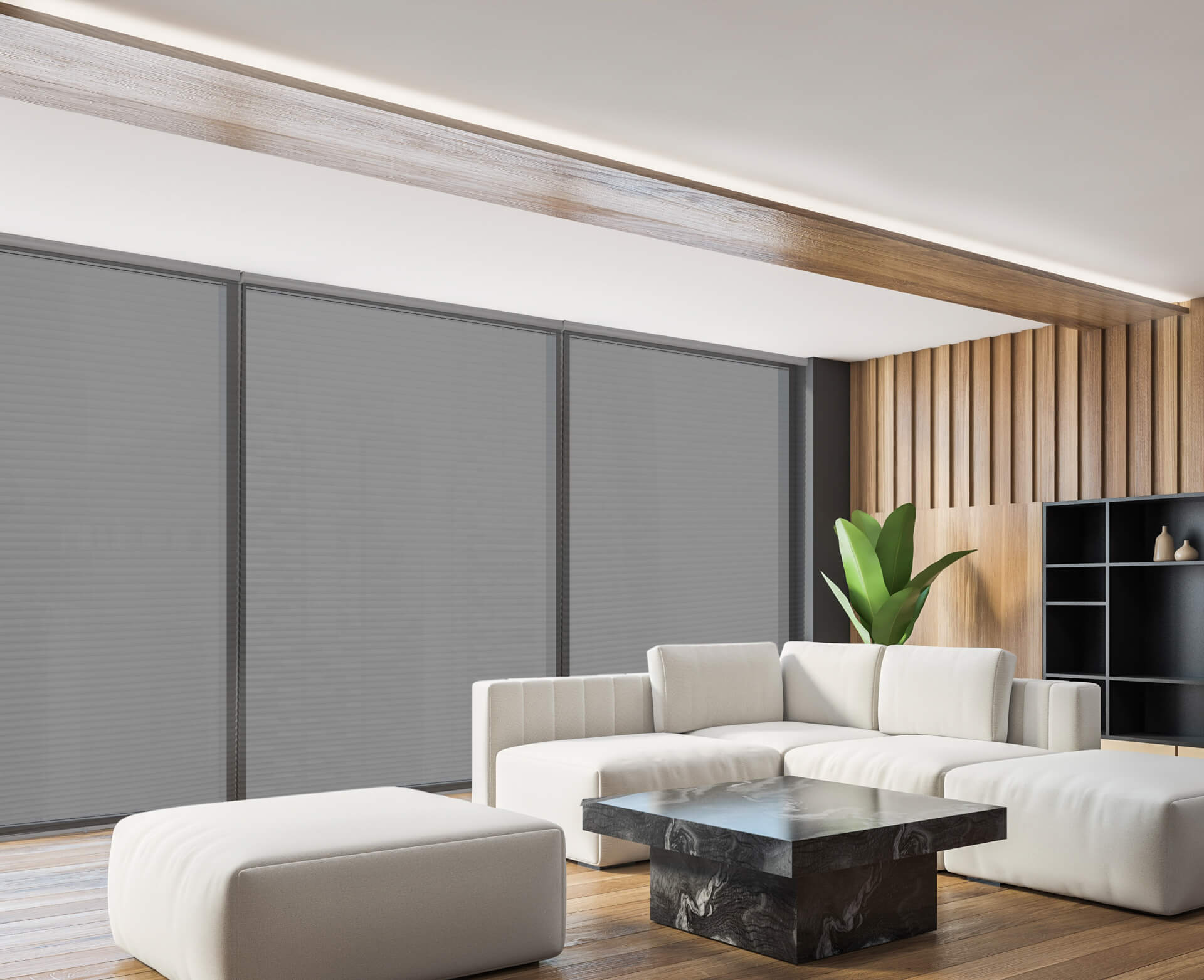
Maxxmar cellular shades — available in light filtering, semi-opaque, and room darkening. 100% Made in Canada.
Why the Honeycomb Structure Changes Everything
The name “honeycomb blind” isn’t just descriptive — it’s the mechanism. When fabric is folded into that repeating hexagonal pattern and mounted across a window opening, each cell acts as a miniature insulating chamber. Still air is one of the best natural insulators. The more of it you can trap in place, the harder it becomes for heat to move in or out through the glass.
A standard window — even a high-performance double-pane unit — has a surface that loses or gains heat rapidly through convection and radiation. A cellular shade mounted flush to the frame dramatically reduces that surface interaction. In winter, the trapped air cushions the room from the cold radiating off the glass. In summer, it slows the rate at which solar heat penetrates into the living space.
Thermal Insulation
The honeycomb cell traps still air between the glass and the room. Still air is a natural insulator. This reduces heat loss in winter and solar gain in summer — lowering the load on your HVAC system year-round.
Acoustic Absorption
The same cells that block thermal transfer also dampen sound. The fabric and trapped air absorb sound waves rather than reflecting them — measurably reducing street noise and echo in rooms with hard surfaces.
UV Protection
Even light filtering cellular shades block a significant portion of UV radiation — protecting floors, furniture, and artwork from fading without eliminating natural light from the room.
Clean Profile
Cellular blinds stack neatly at the top of the window when raised, leaving an unobstructed view. When lowered, the fabric face is smooth and uniform — a visual refinement that suits both contemporary and traditional interiors.
Light Control: From Sheer to Blackout Cellular Shades
One of the defining decisions when choosing cellular blinds for windows is opacity level. Maxxmar cellular shades are available in three opacity categories — and the right choice depends on the room, the orientation of the window, and what you want the light to do.
Diffuses natural light while maintaining daytime privacy. Softens the room with a warm glow. Best for living rooms, kitchens, and any space where you want light without glare.
Greater privacy than light filtering, with reduced — but not eliminated — light transmission. A balanced choice for dining rooms and home offices where you want moderate light control.
Significantly reduces light transmission for sleeping environments, media rooms, and nurseries. Pair with Miracle Fit side channels for near-blackout performance.
For complete light blockage, blackout cellular shades work best when combined with Maxxmar’s Miracle Fit side channels — a two-piece cotton channel system that closes the gap between the shade edge and the window frame. Without addressing the side gaps, even a room darkening fabric will allow light to bleed around the edges. Miracle Fit eliminates that path entirely. Available with any single shade order at $5.10 per linear foot, or as a standalone add-on at $7.60 per linear foot.
Top Down Bottom Up Cellular Shades
Top down bottom up blinds are one of the most practical upgrades you can specify on a cellular shade — and one of the most underused. The concept is straightforward: the shade can be operated from both ends. You can raise it from the bottom as you normally would, but you can also lower it from the top independently.
That opens up a way of managing light and privacy that fixed-position shades simply can’t match. Lower the top section to bring natural light in from above while keeping the lower half — the portion visible from the street — completely covered. In a bathroom, this means a flood of daylight without any compromise to privacy. In a bedroom, it means you can let morning light filter in from the upper window while maintaining complete coverage at eye level from outside.


Top down bottom up cellular shades — light from above, privacy at eye level.
Top down bottom up is available across the Maxxmar cellular shade collection and pairs with both cordless and motorized operation. The cordless version is operated by gently pushing or pulling the bottom or top rail to the desired position — no cords, no chains, and fully safe for homes with children and pets. Motorized TDBU allows each rail to be operated via remote, app, or voice control independently.
Cell Size Guide: 3/8″ vs 3/4″
Maxxmar cellular shades are available in two cell sizes: 3/8″ single cell and 3/4″ single cell. Both deliver the same core benefits — thermal insulation, light control, and acoustic dampening. The decision between them is primarily visual and contextual.
| Feature | 3/8″ Cell | 3/4″ Cell |
|---|---|---|
| Visual texture | Tighter, more refined | Bolder, more pronounced |
| Best window size | Small to medium windows | Medium to large windows |
| Stack height when raised | More compact | Slightly taller stack |
| Insulation performance | Comparable | Comparable |
| Fabric range | Broad — including Struttura, Azores, Evora, Ibiza, Mykonos | Broad — including Mystik, Strata, Textured, Notre Dame, Oxford |
| Maximum cordless size | 90″ × 90″ | 90″ × 90″ |
Day/Night Cellular Shades
The Day/Night cellular shade is a single headrail system with two independent shades built into it — one light filtering fabric and one room darkening. Each operates independently on the same window, giving you the full range from open and airy to completely private, without any hardware on the wall and without needing two separate window treatments.
During the day, run the light filtering shade down to soften the light and reduce glare while keeping the room bright. At night, deploy the room darkening shade for full privacy and sleep-quality light control. The two shades move independently so you can use either alone or both together for maximum coverage.


Maxxmar Day/Night cellular shades — two shades, one headrail, full flexibility.
Day/Night cellular shades are available in BetterFit configurations as well — meaning you can get this functionality in a frame that moves with a casement window when it opens, with no drilling into the window frame itself. Motorization is available for both independent shades, enabling scene-setting from a single remote or your phone.
Specialty Shapes & Skylight Cellular Shades
Most window treatments are designed for rectangular openings. Cellular shades are one of the few products that can extend meaningfully beyond that. Maxxmar’s Framed Specialty Shapes system allows cellular fabric to be installed in arched, angled, triangular, circular, and trapezoidal openings — with fully operable shade functionality, not just decorative covers.


Framed Specialty Shapes — Horizontal
Horizontal specialty shapes address wide windows with angled or curved tops — including true arches, eyebrow windows, and trapezoid configurations. The cellular shade is custom-cut and framed to fill the opening precisely, with a profile designed to accommodate the slope while keeping the fabric under proper tension.


Framed Specialty Shapes — Vertical
Vertical specialty shapes handle tall narrow openings with angled tops, sidelights beside doors, and other non-rectangular configurations where a standard shade would leave gaps at the top. The framing system holds the shade in precise alignment regardless of the angle.


Cellular Skylight & Room Darkening System
Skylights present a unique challenge: the shade needs to operate on a slope, stay under tension regardless of angle, and resist gravity-induced sagging. Maxxmar’s Framed Skylight & Room Darkening System is engineered specifically for this. Available in manual and motorized versions, the four-sided enclosed frame keeps the cellular shade under constant tension at any orientation — flat ceiling, pitched roof, or any angle in between.


Left: Manual skylight cellular shade. Right: Motorized Room Darkening Skylight System.
The manual version is operated with a handle or optional extension pole and is available in three measurement configurations depending on the skylight geometry. The motorized version uses a remote control and is available in 3/8″ single cell only. Both versions are available exclusively with the Framed Skylight & Room Darkening System — they cannot be ordered as standard shades.


Motorized Cellular Shades
Maxxmar cellular shades can be motorized with two dedicated motor systems — the Cellular MaxxMotor Transformer (plug-in, low voltage 12V) and the Cellular MaxxMotor Rechargeable Battery Pack. Both are purpose-built for the cellular shade headrail and integrate with the full MaxxLink smart home ecosystem.
Motorized cellular blinds have a minimum size requirement of 24″ × 12″ and a maximum of 95″ wide × 90″ high. Remotes are available in 1-channel, 5-channel, 15-channel, and 45-channel configurations in both white and black — so a single remote can manage every motorized shade in a room, a floor, or the entire home.
One MaxxLink WiFi hub controls every motorized shade in your home from a single app — anywhere in the world. Compatible with Amazon Alexa, Google Home, Apple HomeKit (Matter protocol), Control4, Savant, Crestron, IFTTT, and Elan. A single unit at $677 retail connects the entire system. Requires any MaxxMotor with remote capability.
For homes with multiple cellular shades, motorization isn’t a luxury — it’s a practical upgrade. Being able to raise and lower all window coverings on a schedule, a scene, or a voice command means your home manages light and heat automatically, without anyone walking room to room adjusting shades manually.
Cellular Shade Fabric Collection
Every Maxxmar cellular shade fabric is 100% Polyester — selected for dimensional stability, consistent cell formation, and long-term colour retention. The full collection spans light filtering, semi-opaque, and room darkening opacity levels across both cell sizes.
Light Filtering (LF)
Semi-Opaque (SO)
Room Darkening (RD)
Dye lots vary within commercial tolerances — Maxxmar does not guarantee exact colour matching across separate orders. For large installations or future replacements, order all panels at the same time. Environmental conditions including heat, humidity, and cold may cause minor wrinkling or bowing of fabrics; this is considered normal and within specification for cellular constructions.
Cellular Blinds Installed Right, Once
A cellular shade is only as good as its fit. The insulation performance, the light control, the operational feel — all of it depends on precise measurement and installation. A shade that’s even slightly too narrow creates a side gap that undercuts every benefit of the honeycomb construction. A headrail that’s not perfectly level binds on one side and rides up on the other.
ECO Glass Windows And Doors handles measurement, ordering, and installation as a complete service. We’re an authorized Maxxmar dealer, which means we have direct access to the full product collection — every cell size, every opacity level, every specialty configuration — and the technical knowledge to specify the right product for your window, your room, and your priorities.
We serve homeowners and builders across Maple, Aurora, Newmarket, Barrie, Vaughan, Richmond Hill, and the broader Greater Toronto Area. Every consultation is free, every quote is detailed, and every installation is backed by Maxxmar’s Lifetime Limited Warranty on cellular shades.
Cellular Shades FAQ
Ready for Cellular Shades That Actually Fit?
Free in-home measurement, expert specification, and professional installation across the Greater Toronto Area.