
Window Coverings Guide
Maxxmar Dream Shade:
Sheer Vertical Blinds You Can Walk Through
Soft fabric vanes that part when you step through, tilt for light control, and bring a sheer elegance to patio doors and large windows that rigid vertical blinds can’t match. By ECO Glass Windows And Doors, official Maxxmar authorized dealer.
What Is the Maxxmar Dream Shade?
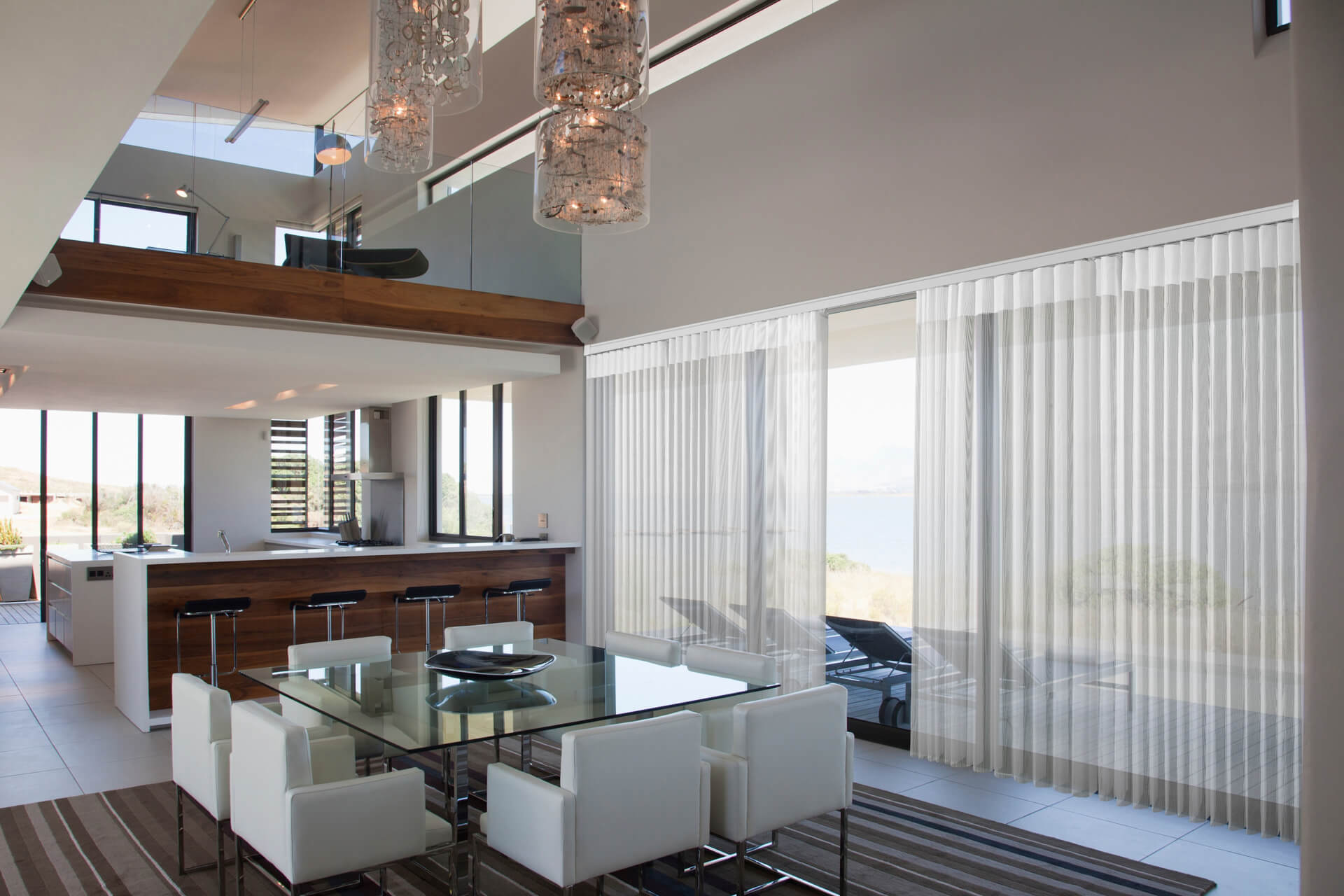
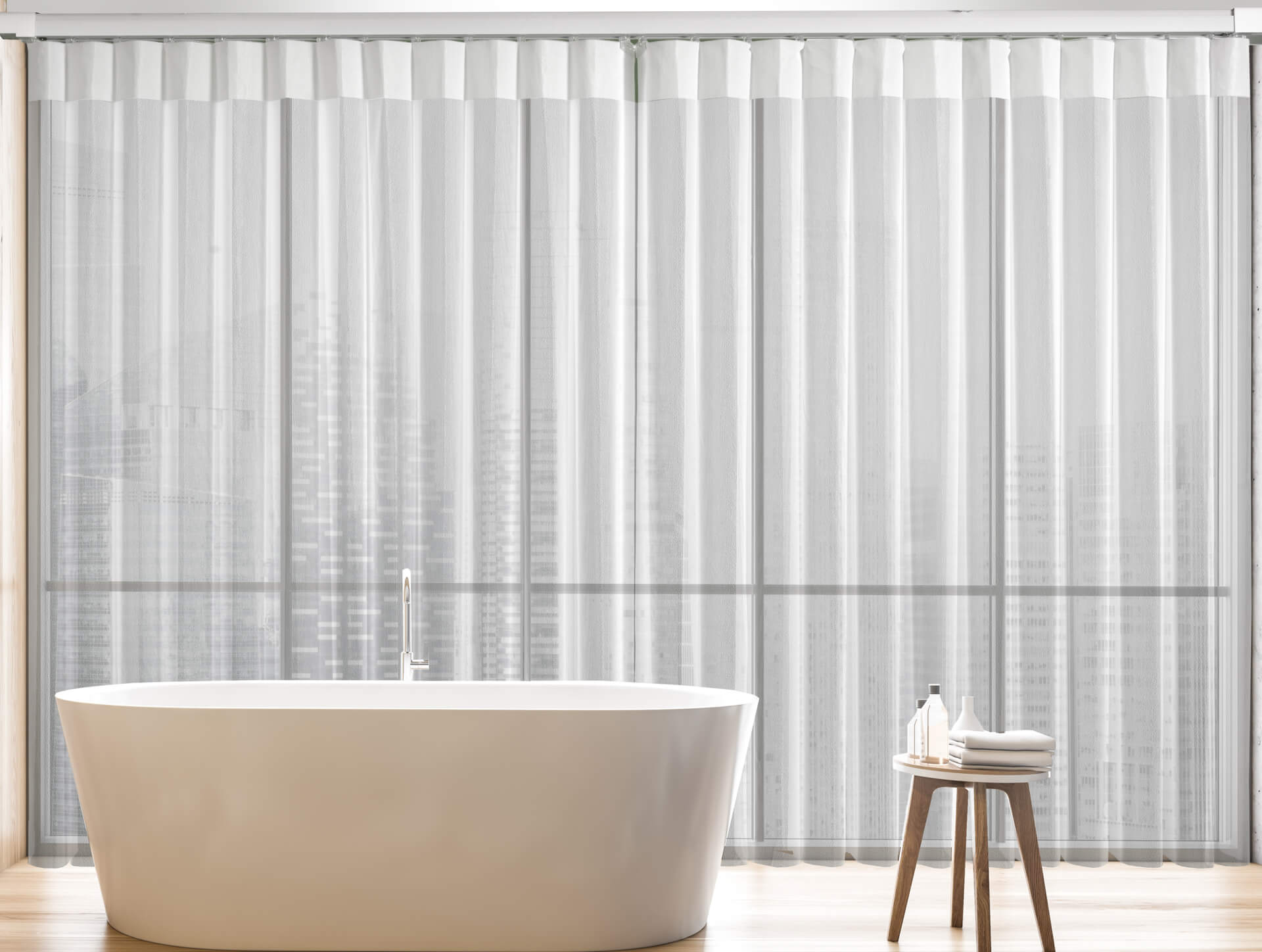
The Maxxmar Dream Shade is a sheer vertical blind — a window covering built from individual soft fabric vanes that hang vertically from a smooth-gliding track. The vanes tilt to control the angle of incoming light, stack to one side (or split from the centre) to open the window or door, and — crucially — gently separate when someone walks through them and return to position on their own.
That last detail is the one that distinguishes Dream Shade from every other product in this guide. Roller shades, roman shades, panel track, cellular shades — all of them have to be raised, stacked, or pushed aside before a door can be used. Dream Shade doesn’t. You walk through it. The vanes part, you pass, they return. For patio doors and any other opening with frequent foot traffic, this changes the entire relationship between the window covering and how the space is actually used.
Maxxmar Dream Shade is 100% made in Canada, available in manual wand control and motorized configurations, and backed by a Lifetime Limited Warranty. ECO Glass Windows And Doors supplies and installs the complete Dream Shade collection across the Greater Toronto Area.
Dream Shade — Full Coverage
 Sheer Fabric Vanes — Light Filtered
 Vanes Stacked — Full Opening
Maxxmar Dream Shade — sheer fabric vanes, walk-through design, 100% Made in Canada.
Walk-Through Convenience — What It Means in Practice
The walk-through design of Dream Shade is not a minor feature — it redefines how a window covering functions at a doorway. Consider a patio door in a family home: the door is opened and closed dozens of times a day. Every time someone steps outside or comes back in, a conventional window covering — a roller shade, a panel track blind, a roman shade — has to be moved out of the way. That’s manageable once or twice. At the tenth time, it becomes a habit to just leave the covering up. Which means it’s not covering anything.
Dream Shade solves this completely. The fabric vanes are engineered to separate under gentle pressure — a hand, a shoulder, a body passing through — and return to their hanging position without any manual resetting. The covering stays in place. Light control and privacy are maintained between uses. The door functions as a door without the window covering becoming an obstacle.
This is the reason Dream Shade exists as a product category. It’s not just a softer version of a vertical blind — it’s a fundamentally different approach to covering a doorway opening.
When Dream Shade vanes are in the closed position, they overlap each other to block the view through the shade. However, the vanes do not contact each other along their full length — some light gap may be visible toward the bottom of the shade, particularly on taller installations. This is a characteristic of the product design, not a defect. For applications requiring full light blockage, a room darkening roller shade behind the Dream Shade is a practical combination.
Dream Shade vs. Standard Vertical Blinds
Both Dream Shade and conventional vertical blinds cover wide openings with vertically hanging panels that tilt for light control and stack to open. The mechanism is similar. The result is completely different.
Rigid PVC or Aluminum Slats
Hard, flat slats that rotate and stack. Functional and durable, but the aesthetic is utilitarian — each slat catches light at a sharp angle, creating hard shadows and a commercial appearance. Common in rental properties and office environments where cost and durability outweigh design refinement. Not walk-through capable — slats must be pushed aside manually.
Soft Sheer Fabric Vanes
Fabric vanes that diffuse light softly rather than blocking or slicing it. The visual result is closer to a sheer curtain than a blind — refined, residential, and dimensional. Walk-through capable by design. Available in a broad range of fabrics, colours, and textures to complement any interior. The right product when the space and the opening deserve more than a utilitarian cover.
Choose Dream Shade When
The opening is a patio door or high-traffic entry, the room is designed with care and the covering should match, or you want soft diffused light with the privacy of a vertical covering — without the hard commercial look of standard slats.
Consider Alternatives When
Complete blackout performance is the priority (Dream Shade is sheer fabric — it filters light, it does not block it), or the opening requires a covering that can be operated entirely without touching it, in which case a motorized panel track may be more practical.
How Dream Shade Controls Light
Dream Shade vanes operate in two ways: they tilt to control the angle of incoming light, and they stack or split to open the window or door opening completely. The tilt mechanism is the primary light control tool — rotating the vanes toward open allows direct light through the sheer fabric; rotating toward closed brings the vanes into an overlapping position that significantly reduces light transmission and blocks direct views from outside.
In the open tilt position, the sheer fabric diffuses sunlight — softening harsh direct light into a warm ambient glow rather than blocking it. This makes Dream Shade particularly suited to south and west-facing rooms where afternoon sun is intense enough to cause glare and fade furniture, but where blocking all natural light is not the goal.
 Vanes Open — Maximum Light
 Vanes Angled — Diffused Light
 Vanes Closed — Privacy Position
Draw Configurations & Cassette Options
One-Way Draw vs. Center Split
Dream Shade manual (wand control) is available in one-way draw only — all vanes stack to one side of the opening when opened. Dream Shade motorized supports both one-way draw and center-split draw, where the vanes divide from the middle and stack to both ends equally. The right configuration depends on the opening.
For a sliding patio door that opens to one side, a one-way draw stacking to the opposite side keeps the vanes clear of the door’s travel path and wall hardware. For a centered window or a French door opening with equal clearance on both sides, a center-split draw creates a symmetrical coverage that opens elegantly from the middle — visually closer to curtains than blinds.
Cassette Options
Manual Dream Shade can be ordered with an optional Compact Cassette or Square Cassette headrail, which dress the track hardware and conceal the mechanism at the top of the window. A surcharge applies for either cassette option. Motorized Dream Shade uses a dedicated motorized headrail. All Dream Shade tracks are white only.
Manual Dream Shade (wand control): minimum 24″ wide × 36″ high, maximum 144″ wide × 144″ high. Motorized Dream Shade: minimum 36″ wide × 36″ high, maximum 240″ wide × 144″ high — with tracks joined for widths beyond 144″. For openings wider than 144″, motorization is the only single-system option.
| Configuration | Min. Size | Max. Size | Draw Options | Cassette |
|---|---|---|---|---|
| Manual — Wand Control | 24″ W × 36″ H | 144″ W × 144″ H | One-way draw only | Optional Compact or Square |
| Motorized — Rechargeable | 36″ W × 36″ H | 240″ W × 144″ H | One-way or center-split | Motorized headrail |
Motorized Dream Shade
Motorized Dream Shade uses a rechargeable battery motor — no wiring required, no wall outlet needed at the window. The motor charges via USB and operates via remote control. Remote options include 1-channel, 6-channel, and 16-channel configurations in white or black, allowing a single remote to control multiple Dream Shade installations throughout the home.
The motorized system unlocks center-split draw as an option, which is not available on manual configurations. For very wide openings — a 180″ or 240″ window wall — motorization is also the only practical operation method, since manually drawing vanes across 15 to 20 feet of track is cumbersome at scale. At those widths, the motor handles the draw smoothly and consistently from a single button press.
Motorized — Center Split Draw
Motorized — Wide Window Wall
Dream Shade Applications
Sliding Patio Doors
The primary application. Walk-through vanes mean the covering stays in place during constant door use. One-way draw stacks vanes to the non-door side — the track stays clear of the door path at all times.
French Doors
Center-split motorized Dream Shade covers French door openings symmetrically. Both door panels remain accessible through the walk-through vanes without needing to stack or raise the shade.
Large Living Room Windows
Floor-to-ceiling windows in open-plan living areas benefit from Dream Shade’s soft light diffusion and the ability to tilt vanes through the day as sun angle changes — without raising the entire shade.
Open-Plan Dividers
A ceiling-mounted Dream Shade track can define zones in an open-plan space while remaining fully accessible in both directions. The walk-through vanes eliminate the visual and physical barrier that a panel track would create.
Dream Shade Installation Across the GTA & Beyond
ECO Glass Windows And Doors is based in Maple, Ontario and serves homeowners, builders, and renovators across the Greater Toronto Area and surrounding regions. Every city below is part of our regular service territory.
Don’t see your city? Call 647-272-7219 — we may still serve your area.
Dream Shade FAQ
Get Dream Shade Measured & Installed Right
Free in-home consultation, expert specification, and professional installation — serving the GTA and surrounding communities.